Practice Heroes, Game Zeroes: The Hidden Variables Your Batting Cage Never Tests

Photo: No machine-readable author provided. Ksax assumed (based on copyright claims)., CC BY-SA 2.5, via Wikimedia Commons
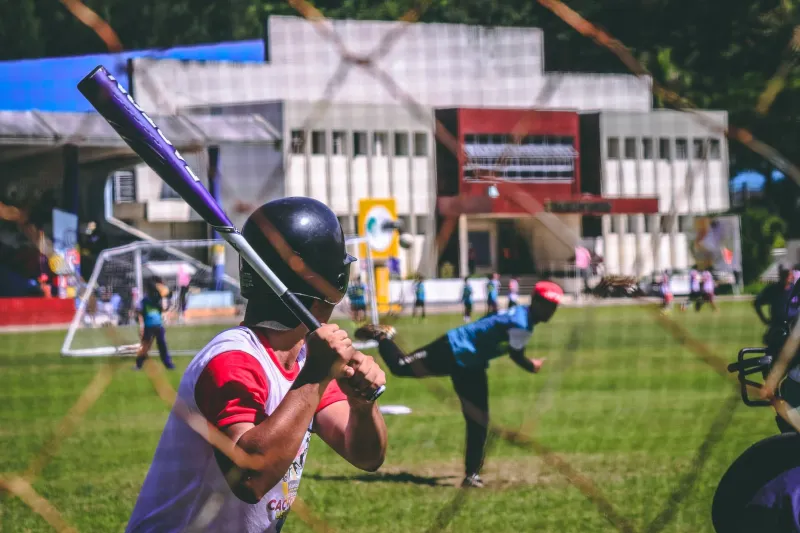
Every travel ball coach has seen it. A hitter who posts video of laser shots off the pitching machine, then walks back to the dugout after three competitive at-bats wondering what happened to the swing that looked so clean an hour earlier.
The standard explanation — "he's just not locked in" — misses the point entirely. The cage environment is a controlled laboratory, and games are anything but. Until a training program accounts for what the cage strips away, that gap will keep swallowing otherwise talented hitters.
What the Cage Quietly Deletes
Consider everything a batting cage session removes from the hitting equation.
Pitch identity is gone. Machines deliver repetition with near-identical release points and trajectory. A game pitcher — even a mediocre one — mixes arm angles, speeds, and spin at a rate no machine replicates. The hitter who has only seen one pitch shape for two months has not actually practiced hitting. He has practiced swinging.
Consequence is absent. In the cage, a bad rep costs nothing. There is no count, no runner on second, no catcher framing a borderline pitch to steal a strike. Japanese coaches describe this as training without "ba" — the situational context that gives every swing its meaning. American programs often treat context as a garnish; Japanese practice design treats it as the main course.
The environment is sterile. Cage lighting is flat and predictable. Game lights create shadows behind the mound. Cage background is a net; game background is a moving catcher, an umpire shifting in his stance, a crowd. Vision science researchers have long noted that contrast and background clutter measurably affect a hitter's ability to pick up the ball early. Training exclusively in a sterile tunnel means the first genuinely difficult visual conditions a hitter faces occur in a game that counts.
The Japanese Answer: Chaos on Purpose
What separates much of Japanese player development — from youth leagues to the famed high school summer tournament at Koshien — is a deliberate insistence on introducing game-like disturbance early and often.
Rather than perfecting a swing in isolation and hoping it survives contact with reality, Japanese practice structures are built around what coaches there call "hensen" — the transfer of practice to performance. A drill that doesn't transfer is considered entertainment, not training.
Several principles stand out:
Randomized pitch sequences. Instead of fifteen straight fastballs, hitters face an unpredictable mix. Coaches flip coins, call pitches from behind a screen, or vary speed drastically between throws. The cognitive load of pitch identification becomes part of the rep itself.
Consequence-driven rounds. In many Japanese team practices, a hitter's round continues only while he produces the called outcome — a ground ball to the right side, a fly ball deep enough to score. Failure ends the round and sends the next hitter in. Every swing carries weight, replicating the pressure chemistry of a real at-bat.
Environmental disruption. Practices are intentionally scheduled at odd hours, in poor light, or with teammates creating noise and movement. It sounds almost cruel until you watch a Koshien hitter step into a packed stadium with the composure of someone who has seen chaos a thousand times before.
Three Drills That Bring the Game Into Your Training
American hitters can borrow this philosophy without rebuilding their entire program. Start here.
1. The Coin-Flip Round. Have a coach or teammate flip a coin before each toss — heads, fastball velocity; tails, off-speed at 70 percent. The hitter gets no verbal cue and must read speed and flight before committing. Ten reps, tracked for hard-contact quality, not just fair balls.
2. The Two-Strike Simulation. Every rep is executed with an 0-2 or 1-2 count in mind. The hitter must shrink his zone, compete for contact, and fight off pitches he'd otherwise take. Rotate through all counts across a week so no situation feels foreign on game day.
3. Lights-Out Timing Work. Once a week, take front toss in the worst available lighting — a dim corner of the facility, early evening outdoors. The goal is not mechanics; it is training the visual system to extract ball flight from degraded conditions. Hitters report the ball looks bigger when the lights come back on.
Closing the Gap Before It Opens
The uncomfortable truth is that cage numbers are a measure of comfort, not competence. A hitter can post machine-numbing exit velocities all winter and still be unprepared for the first curveball that starts at his chest and falls onto the corner.
The fix is not more swings. It is more honest swings — reps embedded in randomness, pressure, and imperfect conditions. Japanese baseball culture figured out generations ago that the game does not negotiate with practice that doesn't resemble it.
Train for the game, not for the tunnel. Your stat line will thank you by May.