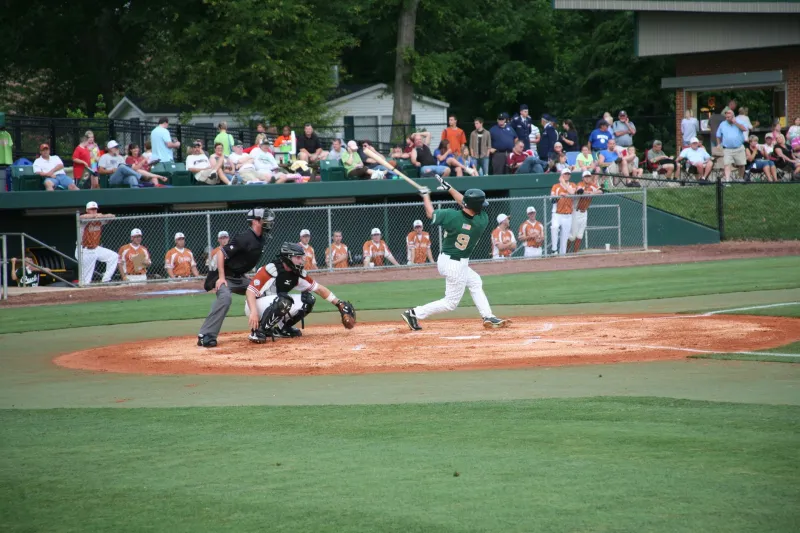
Wired to Be Early: How Japanese Timing Systems Expose the Training Flaw Quietly Sabotaging American Hitters

There is a frustrating irony embedded in the development of most American hitters. The more time a young player spends in a batting cage, the more likely he is to build a timing pattern that works beautifully against one pitch speed and collapses against everything else. It is not a question of effort. It is not a question of talent. It is, according to the structured timing methodologies practiced inside Japanese baseball academies, a direct consequence of how most American training environments are designed.
The problem has a name in Japanese coaching circles: hayauchi bias, or roughly, the tendency toward premature commitment. And for the overwhelming majority of youth hitters in the United States, this bias is not an accident. It is trained into them, one repetitive cage session at a time.
The Cage as a Timing Trap
Walk into any batting facility in the country and you will observe the same scene: a player steps into a cage, the machine fires a pitch at a fixed speed, and the hitter swings. Then again. Then again. Over hundreds of repetitions, the hitter's nervous system does exactly what it is designed to do — it finds the pattern and optimizes for it.
The problem is that baseball does not operate on a fixed pattern. Pitchers at every level above youth recreation vary velocity, spin, and release point. Yet the training environment most American hitters spend the majority of their development years inside is, by design, a single-speed, single-trajectory loop.
Neurologically, this matters more than most coaches acknowledge. When a hitter grooves a timing pattern against a machine throwing 55 miles per hour, the brain is not simply learning to swing a bat. It is calibrating a predictive model — a neurological countdown that begins from the moment the pitch is released and ends at the point of contact. The more that countdown is rehearsed against the same stimulus, the more rigid it becomes.
The result is a hitter who looks sharp in the cage and falls apart against a pitcher who mixes speeds.
How Japanese Academies Define the Timing Window
In contrast to the repetition-heavy, fixed-speed approach common in American youth development, Japanese baseball programs — particularly those affiliated with high school powerhouses and NPB feeder academies — structure timing training around what coaches refer to as the ma concept: the space between stimulus and response.
Ma does not translate cleanly into English, but in a batting context it describes the discipline of expanding the decision window rather than narrowing it. Where American training often inadvertently rewards early commitment — because early commitment works consistently against a machine — Japanese methodology explicitly trains hitters to resist that impulse and hold their recognition phase longer.
This distinction has a direct neurological basis. Research in motor learning consistently demonstrates that athletes trained to delay their go/no-go decision until later in a movement sequence develop more adaptable response patterns. Early commitment, while efficient against predictable stimuli, produces what sports neuroscientists sometimes call anticipatory rigidity — the hitter has already decided to swing before the pitch has revealed enough information to justify that decision.
Japanese timing drills are built to combat this. Variable-speed toss sequences, intentional deception in live batting practice, and the deliberate incorporation of off-speed pitches into every training session from early developmental stages are all standard tools. The goal is not to make the hitter faster. It is to make the hitter's internal clock more elastic.
The Neurological Gap Between Early and Late Timing
Understanding why this matters requires a brief examination of how the brain processes pitch recognition. From the moment a pitch is released, a hitter has a narrow window — generally estimated between 100 and 150 milliseconds — to gather enough visual information to make a swing decision. Elite hitters are not necessarily faster processors. They are more efficient ones. They extract more usable information from the same window.
Hitters trained on fixed-speed machines learn to make that decision early in the window, because early decisions are rewarded with solid contact in that environment. But this early commitment means the hitter is acting on incomplete information. Against a fastball, incomplete information often still yields a good result because the pitch does what the brain predicted. Against a changeup or a breaking ball, that same early commitment sends the hitter lunging at air.
Japanese timing systems train the opposite reflex. By repeatedly exposing hitters to uncertainty — not knowing what speed or shape is coming — these programs force the brain to stay in the recognition phase longer before committing. Over time, this builds what might be called a flexible countdown: a timing mechanism that can compress or expand depending on what the pitch is doing, rather than firing on a fixed schedule.
Practical Adjustments for American Programs
The encouraging reality is that American coaches do not need to overhaul their entire philosophy to begin correcting this issue. Several targeted adjustments can start rewiring a hitter's internal clock without abandoning familiar training structures.
Introduce variable-speed sequencing early. Rather than running all fastball rounds followed by all off-speed rounds, mix speeds within the same session from the beginning. The brain adapts to what it is repeatedly exposed to. If uncertainty is a constant, adaptability becomes the trained response.
Reduce machine-only volume. Pitching machines are valuable tools, but their fixed-speed consistency can become a liability in high volume. Supplementing with front toss from a human arm, live batting practice, and even irregular-bounce tee work builds a more responsive internal clock.
Teach hitters to track release points, not just the ball. Japanese academy hitters are frequently coached to key on the pitcher's release point as the primary timing anchor, rather than tracking the ball from release to contact. This earlier read allows more processing time and reduces the pressure on the late-window decision.
Use deliberate deception in practice. Coaches who occasionally call out one pitch and throw another — within reason and safety — are not playing games. They are building the cognitive flexibility that separates hitters who handle velocity changes from those who do not.
Rethinking What Practice Is Actually Building
At the core of the Japanese timing philosophy is a principle that deserves broader adoption in American baseball culture: practice does not simply build skill. Practice builds expectation. And when the expectation that practice builds does not match what a hitter will face in competition, no amount of repetition closes that gap.
The hitters who struggle most against off-speed pitches are not, in most cases, athletically limited. They are expectation-limited. Their training has taught them to expect a specific pitch at a specific time, and their nervous system has optimized accordingly.
The swing itself may be technically sound. The load may be efficient. The bat path may be clean. But none of that matters if the timing mechanism firing the whole sequence is calibrated to a stimulus that only exists in the cage.
Japanese academies have understood this for decades. The growing body of sports neuroscience research supports it. And for American coaches willing to examine not just what their players practice, but what their practice is actually teaching, the path toward more consistent, adaptable hitters runs directly through this single, often-overlooked variable: the timing of the decision, not the mechanics of the swing.